 Young Critic
· 4 min read
Sense and Sensibility (2026)
The newest adaptation is bold to follow up on the classic, but largely succeeds
Leer en español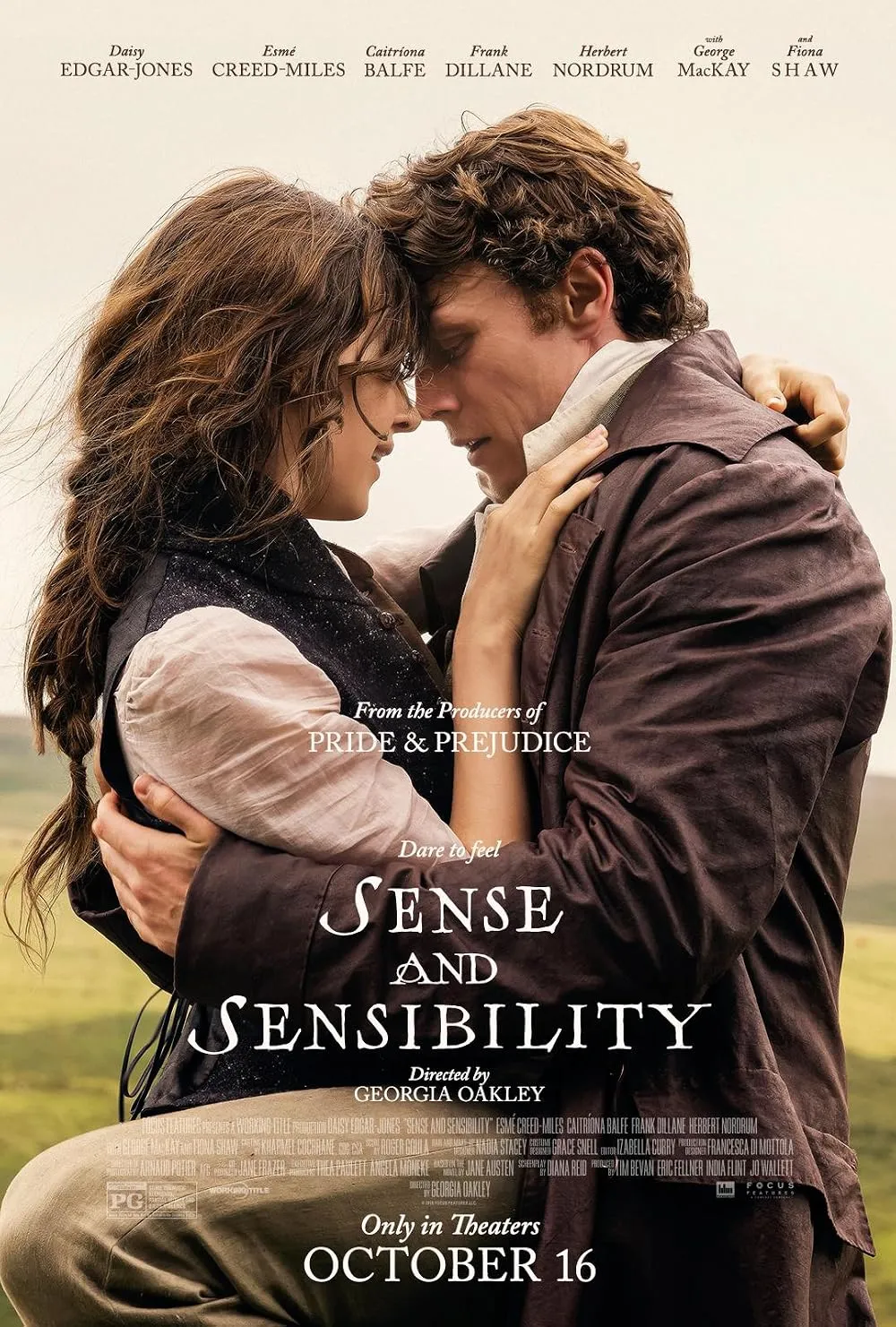
Jane Austen’s oeuvre is varied, if not as extensive as, say, Stephen King’s, yet the 19th-century British author has had her smaller collection of novels adapted countless times, as viewers can’t get enough of the same characters and stories. What is it about these forbidden romances and navigation of class and wealth that captivates us so? Perhaps in today’s world of loneliness epidemics and chasm-like class inequalities we find her themes more relevant than ever. Nevertheless, to try and remake an adaptation that is already considered a classic is a bold undertaking. That has not stopped Georgia Oakley from picking up the baton from Ang Lee and making her own Sense and Sensibility (2026).
Sense and Sensibility follows the recently fatherless Dashwood family: matriarch Mrs. Dashwood (Caitríona Balfe) and her three daughters, the collected and composed Elinor (Daisy Edgar-Jones), the bold Marianne (Esmé Creed-Miles), and the nature-loving Margaret (Bodhi Rae Breathnach). Finding themselves penniless as their married half-brother John (Tom Brooke) inherits from their father, the Dashwood women are forced to downsize to a faraway cottage. Yet this doesn’t dampen their romantic hopes that their love interests will swoop in to save them, be it the humble and dashing Edward (George MacKay) with Elinor, or the quiet and stiff Colonel Brandon (Herbert Nordrum) with Marianne.
This is only Oakley’s second feature film, after her critically acclaimed debut Blue Jean (2022). Following the 1995 version, which starred Emma Thompson (who won an Oscar for adapting the screenplay) and a young Kate Winslet, is an intimidating thought, yet Oakley’s version is largely successful. Oakley includes more of the book’s storylines that had been trimmed in the previous version, and draws the intricate web of cousins, aunts, brothers-in-law, etc. with clarity for viewers. There is a greater emphasis on sisterly love than in previous adaptations, which are heavily focused on the romance, and a less polished atmosphere and look to 19th-century rural England than the usual pristine adaptations have depicted. The squalor that the Dashwoods descend to is drawn as grimy and uncomfortable, not a cute cottage life. Likewise, the elements of muddy travel and a stuffy London are welcome pivots to more period-accurate depictions of this history.
At the end of the day, however, Austen is revered and championed for the art of the romance, and Sense and Sensibilitydoesn’t hold back on this account. Curiously, the biggest boon is also the biggest flaw in the film, which is that MacKay and Edgar-Jones have a winning and effortless chemistry between them. Theirs is the central will-they-won’t-they romance that the story hinges on. Oakley does well to take her time in the first act to establish their rapport, and to have the glances of longing and sighs of desire etch themselves in our minds. Such is their connection that their reunion is a constant cloud that hangs over the rest of the film. This successful pairing, however, contrasts unfavorably with the rest of the important relationships in the film. By leaning into the sisterly bond, Oakley makes this layer the true message of this adaptation, yet the rapport and bickering between Marianne and Elinor never feel as witty or crackling as in the 1995 version, and pale horribly in comparison with Edward and Elinor’s chemistry. As such, this emphasis is watered down in comparison and comes across as a fact that is stated rather than shown. The same is true of Marianne’s dalliances with multiple suitors, none of whom prove to be of much interest to viewers, as we don’t grow to care enough about either Marianne or the men she pursues. That’s not to say it was a faltering performance; Creed-Miles brilliantly encapsulates the daring and unrestrained spirit of Marianne, but she never fully clicks convincingly with either her sister or her romances.
MacKay and Edgar-Jones, the two stars of the film, have shown themselves to be performers with great promise and prolific workers. Both appear to be on the verge of the A-list without fully breaking through. Yet this has allowed them to get more varied work as a result. MacKay can pick films ranging from an apocalyptic musical in The End (2024), to an unorthodox parenting film in Captain Fantastic (2016), a fishing ghost story in Rose of Nevada (2025), or a WWI epic in 1917 (2019). He makes for one of the strongest Edwards to be put to the screen, exuding a charm and nobility that showcase an incredibly chameleonic range for the actor, compared to his other roles. Edgar-Jones, meanwhile, started off big in Normal People (2020), and while she’s continued popping up in mainstream films from Twisters (2024) to Where the Crawdads Sing (2022), she hasn’t had the meteoric rise her co-star on the Hulu miniseries, Paul Mescal, has had. Nevertheless, she’s been picking daring and varied projects as well, proving her charisma and dramatic chops are malleable. Both MacKay and Edgar-Jones deliver winning performances in Sense and Sensibility, and one hopes they continue to feel unrestrained in choosing their next projects, and that their contagious chemistry can be replicated again in the future.
In the end, Georgia Oakley delivers a strong and winning adaptation of the classic novel. While still in the shadow of the 1995 version, it is able to delve deeper into the novel itself, and delivers one of the most captivating central romances of these characters put to screen. Sadly, it is a strength that overshadows the more tepid elements of the rest of the film, proving to be both a blessing and a weight at the same time.